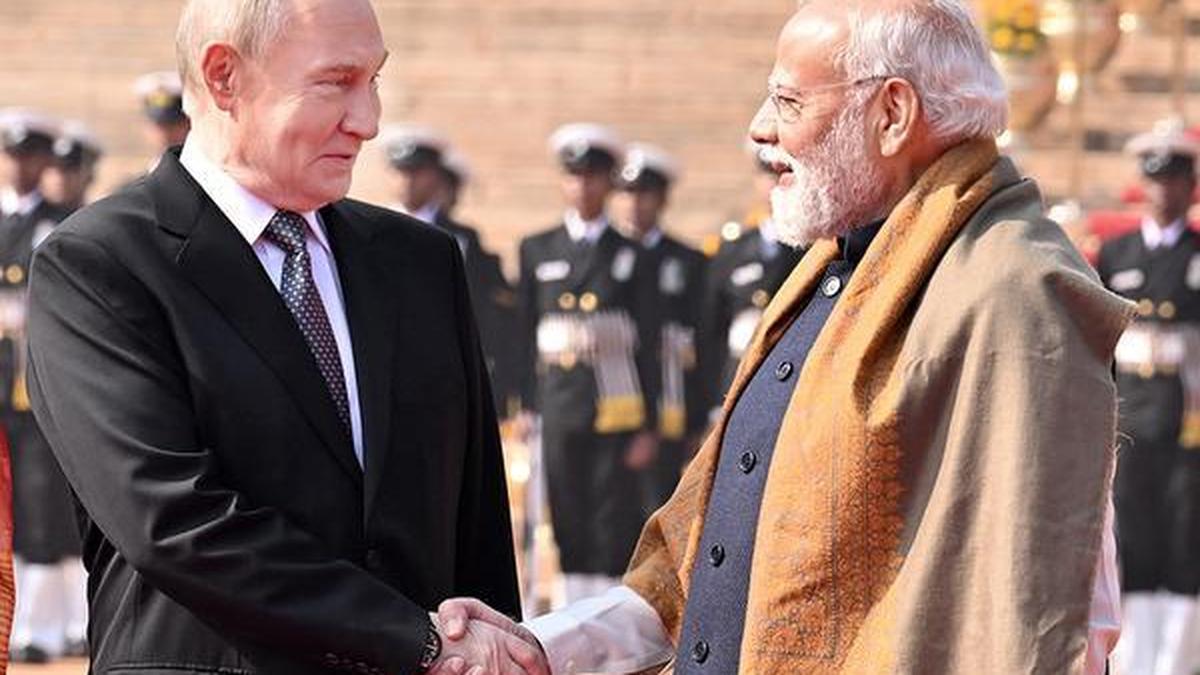
Russian President Vladimir Putin being welcomed by President Draupadi Murmu and Prime Minister Narendra Modi during the ceremonial reception at the Rashtrapati Bhavan in New Delhi on December 5, 2025.
| Photo Credit: R.V. Moorthy
The story so far: In terms of protocol, the government gave Russian President Vladimir Putin his warmest welcome yet. Prime Minister Narendra Modi received him on the red carpet at the New Delhi tarmac, and then travelled with him to the PM’s residence for a private dinner. At the end of the 30-hour trip, President Droupadi Murmu hosted him for a banquet as well. Mr. Modi called the India-Russia relationship steady like a “pole star (dhruva tara)”. However, the outcome of the Modi-Putin summit has been modest.
What are the main takeaways?
Ahead of Mr. Putin’s visit, his first since the Russian invasion of Ukraine in February 2022, the India-Pakistan conflict this year, and the downturn in India-U.S. ties, there was considerable speculation that the two sides were working on a substantial set of agreements on defence cooperation, procurement and technology transfer deals in aircraft, air defence systems, drones and missiles. However, the meeting between Defence Minister Rajnath Singh and his Russian counterpart Andrei Belousov before Mr. Putin landed, ended without any announcements. Instead, the focus was squarely on economic cooperation, and taking forward the roadmap on the “Development of Strategic Areas of India — Russia Economic Cooperation till 2030” that was launched during Mr. Modi’s visit to Moscow in 2024. To this end, they announced a “Labour Mobility Agreement” that will facilitate Indian skilled workers to work in Russia, where manpower shortages for three million jobs are expected by the end of the decade. Russian and Indian fertilizer companies also signed an MoU to build a urea plant in Russia. Apart from this, the two sides signed agreements on maritime cooperation, ports and customs. The two sides expected to smooth the path for bilateral trade, particularly via the Chennai-Vladivostok Eastern Maritime Corridor and International North South Transport Corridor. India and Russia agreed to continue working towards enhancing the settlement of bilateral trade in their national currencies. There were no announcements, however, on oil procurement, that made up more than $60 billion of the $69 billion trade last year, nor were there any concrete outcomes on space and nuclear cooperation.
Was the Ukraine war a factor?
Mr. Putin’s visit to India, at a time the Ukraine war could head into its fourth year, was significant, as it came during intense negotiations over a U.S.-led peace proposal aimed at ending the conflict last week in Moscow. In comments to the media prior to their talks, Mr. Modi thanked Mr. Putin for “always keeping India briefed” about the conflict, and hoping for it to end. “India is not neutral, it stands on the side of peace,” Mr. Modi said. Mr. Putin too said he hoped for peace, and signalled some hope for the U.S. proposal. However, the larger shadow over the talks was of Western sanctions on Russia that have exacted a high cost on India. While Mr. Putin promised “uninterrupted fuel supplies to India”, and the Ministry of External Affairs (MEA) has said it would only bow to “commercial considerations” on oil purchases, it would seem European sanctions on Russian and Indian oil companies as well as the hefty 25% tariff added on to Indian goods by the U.S. have dented India’s resolve. Figures show, that in 2025, the year-on-year intake of Russian oil has been cut drastically (38% y-o-y down in value in October 2025). The two sides may have also stayed away from announcements in the field of defence, space and nuclear cooperation during Mr. Putin’s visit, just in case the U.S. revisits its 2018 CAATSA (Countering America’s Adversaries Through Sanctions Act) law that sanctions strategic purchases from Russia. In addition, a warning shot from three European Ambassadors (the U.K., Germany and France) in an article criticising Russia for the war in Ukraine, that appeared just days before Mr. Putin’s visit, may have given the government some reason to pause, even though the MEA called the article’s “public advice” to India, “unacceptable”. It is also significant that Ukrainian President Volodymyr Zelenskyy, who had last year criticised Mr. Modi for embracing Mr. Putin in Moscow, remained silent on the hugs and bonhomie in Delhi, possibly due to some deft diplomacy by New Delhi, and owing to the sensitive stage the U.S.-led peace talks are at.
What can be the way forward?
For New Delhi, an end to the conflict in Ukraine will ease the tightrope walk it is currently being forced into due to the deep polarisation between Russia and Europe, and as Russia’s dependency on China grows. Mr. Putin’s visit came just a month before likely visits from German Chancellor Friedrich Merz and the European Union’s top leadership Ursula Von Der Leyen and Antonio Costa for Republic Day. The EU-India Summit is being held after a long gap, and the EU-India Free Trade Agreement is expected to be signed. In February, New Delhi expects French President Emmanuel Macron and other Western leaders at the Artificial Intelligence Summit, and Canadian PM Mark Carney thereafter. Meanwhile, the India-U.S. free trade agreement, that hopes to see a rollback of excessive U.S. tariffs, is also in a decisive phase. In that sense, New Delhi hoped the Putin-visit, that was long delayed, would be a “win-win.” It wanted the visit to be a reaffirmation of its traditional ties with Russia, while ensuring the outcomes did not raise a protest from the West. This would allow India to continue to uphold its decades-old policy of “strategic autonomy.”
Published – December 07, 2025 03:17 am IST
