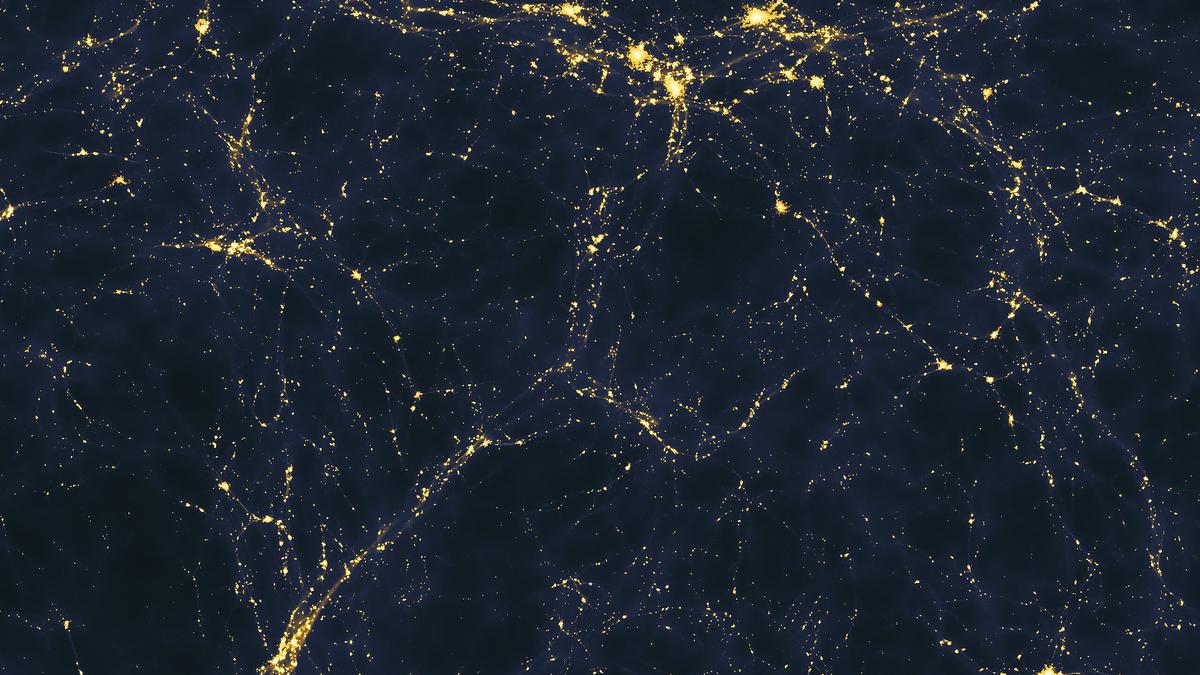
A computer model showing filaments, walls, and voids forming web-like structures in the universe.
| Photo Credit: Andrew Pontzen and Fabio Governato
Cosmic or galaxy filaments are the largest ‘threads’ in the universe’s cosmic web. A single cosmic filament is a structure spanning hundreds of millions of lightyears, formed as a result of gravity pulling in gas, dark matter, and galaxies into long, thin strands that link giant clusters of galaxies. Filaments also surround large, empty regions of space called voids.
A filament forms where sheets of matter intersect and collapse; they’re also highways along which gas and smaller galaxies ‘flow’ towards big clusters. As material falls in, it can spin up both the filament and the galaxies embedded in it. Because of this, filaments help decide where galaxies form, how fast they grow, and how much fresh gas they receive over billions of years.
Astronomers map filaments by measuring the positions and distances of many galaxies and then tracing the patterns they form in the sky. Computer simulations have shown similar webs, giving astronomers confidence that these structures arise naturally from small ripples in the early universe and grew under gravity’s influence into the vast, connected network we see today.
On December 3, University of Oxford researchers reported a roughly 50-million-lightyear-long filament traced by at least 14 galaxies. In particular, the team found the way the galaxies were spinning lined up with the filament, suggesting the entire filament was slowly rotating. Thus the team has claimed it is “one of the largest spinning structures ever found in the universe”.
Published – December 07, 2025 01:30 pm IST
