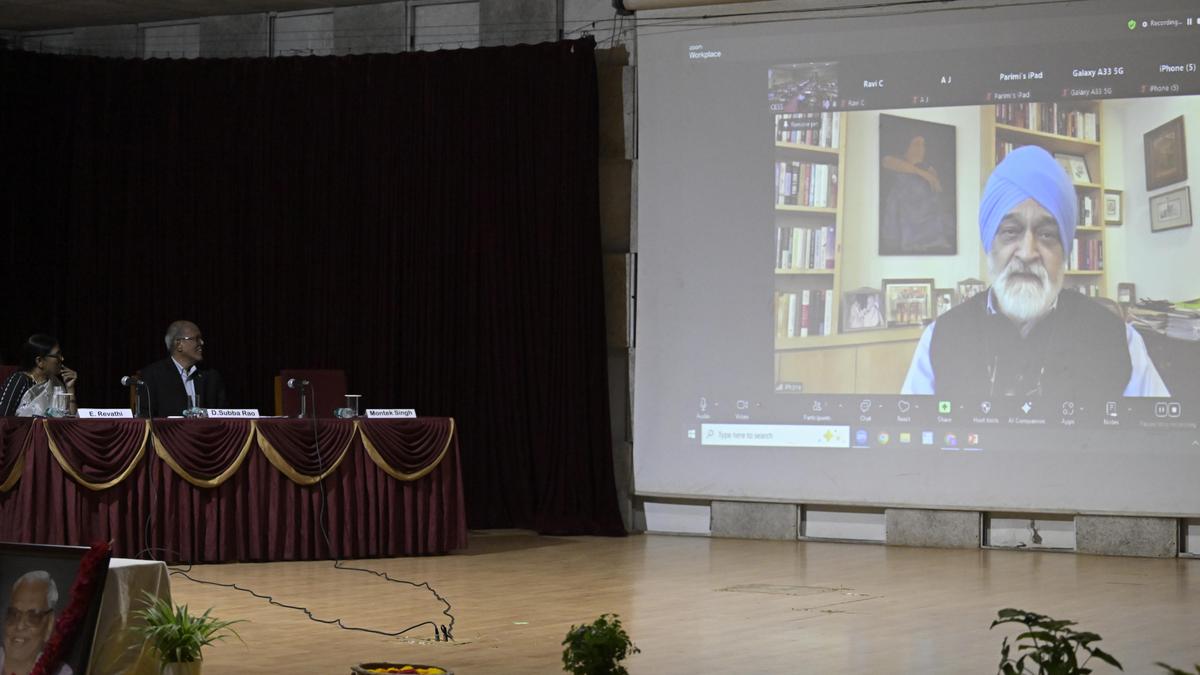
Indian economist and former Deputy Chairman of the Planning Commission of India, Montek Singh Ahluwalia, will virtually deliver the 4th B.P.R. Vithal Memorial Lecture at Centre for Economic and Social Studies (CESS) in Hyderabad on December 1, 2025.
| Photo Credit: Siddhant Thakur
India is entering an economic transition far more complex than the breakthrough movement of 1991, and must urgently adapt to its governance, fiscal strategy, State-level regulatory systems and external economic approach if it is to raise long-term growth from the current 6.5% GDP trend to 8%, said Economist and former Deputy Chairman of the Planning Commission, Montek Singh Ahluwalia while virtually delivering the 4th B.P.R. Vithal Memorial Lecture at the Centre for Economics and Social Studies, Hyderabad on Monday (December 1, 2025).
Mr. Ahluwalia argued that India’s reform challenges are now qualitatively different from the early liberalisation phase, which mainly required persuading bureaucrats, while today’s problems cut across federal politics, climate pressures, technology disruptions and global geopolitical fragmentation.
He added that India’s domestic target of becoming a developed nation by 2047, as outlined in the Viksit Bharat vision, requires consistent real growth of about 8% and cautioned that such a shift cannot be assumed simply because recent quarterly numbers have occasionally touched higher levels. He stressed that the underlying growth rate remains around 6.5%, and while good policies can push it upwards, bad policies can lower it quickly in a volatile world.
Mr. Ahluwalia outlined three major global shifts that India must adjust to. The first is the sharp deterioration in the global geopolitical environment. The second shift is the transformation in global trade patterns as economies rethink supply chains, and the third shift is the acceleration of technological change.
“Unlike earlier waves of innovation that allowed labour markets time to adjust, current disruptions may eliminate large segments of modern-sector jobs very quickly, while creation of new jobs may lag,” he added.
Mr. Ahluwalia argued that India’s biggest development gaps remain health and education, both of which fall largely under State governments and require significant increases in public spending. He said agricultural research, climate-resilient farming, and water conservation will also need higher State-level expenditure.
At the same time, modernising industry and strengthening domestic R&D cannot be done without a larger central fiscal commitment, because private investment in research remains very low.
“Many policy discussions today list dozens or hundreds of reforms, but India needs a narrowed set of priorities for the next five years and a national consensus around them. India must choose credibility by aligning its tariff regime with economies that remain committed to open markets,” he said.
He further added that India should expect States to grow at different rates, which will lead to more migration. He said this is economically positive and will create political pressures, especially in richer States with slowing population growth that will need to attract labour.
Published – December 01, 2025 07:23 pm IST
