“We have no eternal allies, and we have no perpetual enemies. Our interests are eternal and perpetual, and it is our duty to follow them.” — Lord Palmerston
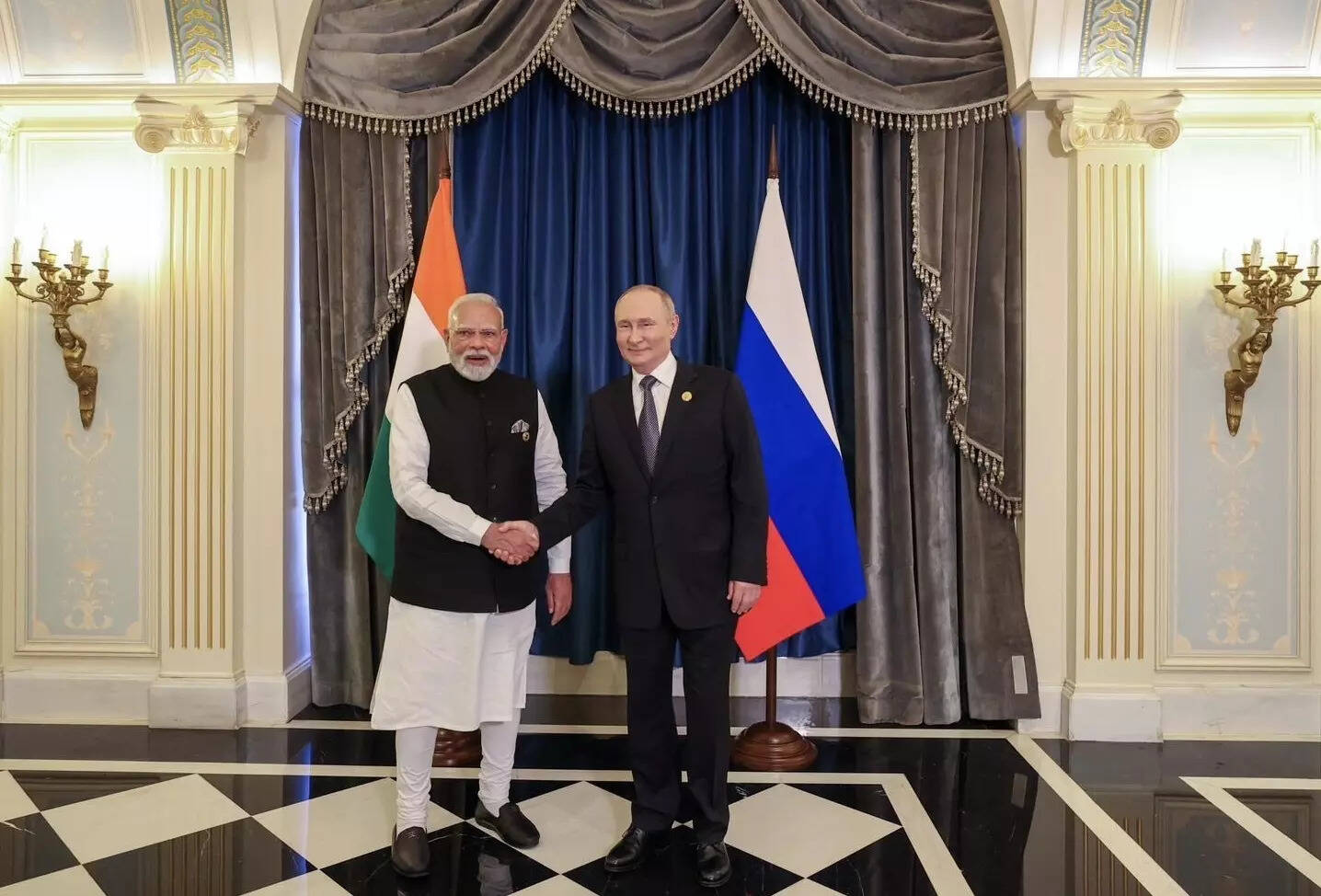
President Vladimir Putin’s visit to India on December 5–6 is not merely a diplomatic formality. It is a punctuation mark in the evolving grammar of world politics.
After four years of caution, quiet engagement, and transactional pragmatism, the India–Russia relationship returns to the stage of visible statecraft. The visit signals that power is once again shifting across continents, and that India remains the pivotal arena in this new realignment.
This is a moment when Washington watches with suspicion, Beijing watches with calculation, Moscow watches with expectation, and New Delhi watches with the calm of a civilisation that has weathered every empire and waited out every storm.
Henry Kissinger once warned that “Great powers do not fade away; they fade into irrelevance only if others write their script.” India, by hosting Putin with the honours of a time-tested partner, is refusing to let anyone else write its script.
What India Seeks: Autonomy Rooted in History, Driven by Interest
At the heart of this summit lies a simple but profound question: What does India want from Putin’s arrival? The answer is not contained in transactional bargains alone but in the deeper currents that shape India’s strategic psychology.
India seeks to preserve a world where no single superpower dominates the narrative. A strong and autonomous Russia suits India because a weakened Russia becomes dependent on China, thereby disturbing the delicate equilibrium of Asia. India wants Moscow to retain enough agency to prevent Beijing from becoming the uncontested centre of gravity across Eurasia.
Prime Minister Narendra Modi articulated this philosophy when he observed that “India will engage with all powers in a manner consistent with its own national interest.” This is not nostalgia for the Indo-Soviet era; it is strategic necessity.
Russia remains essential for India’s defence architecture. Even today, behind the glittering announcements of diversification and indigenisation, much of India’s air defence shield, undersea deterrence, and missile systems rest upon Russian foundations. As one senior Indian Air Force officer remarked, “A nation’s alliances may change, but its readiness cannot depend on the mood of others.”
The economic dimension also matters. Energy cooperation, critical minerals, nuclear power, civil aviation projects, and future connectivity initiatives—from the Northern Sea Route to the International North-South Transport Corridor—reflect a long-term vision that transcends political cycles.
Washington Watches: Will Trump Be Affronted?
The United States under President Donald Trump has embraced a foreign-policy grammar stripped of ornamentation. Trump has repeatedly declared, “We will put America first—every time, all the time.” The consequences of that doctrine ripple far beyond American shores.
In recent months, India has faced a barrage of trade barriers, tariff escalations, and thinly veiled threats of sanctions linked to its dealings with Moscow. Legislation such as the Sanctioning Russia Act, proposing punitive duties on countries purchasing Russian commodities, hangs over India like a sword suspended by a fraying thread.
There is little doubt that the pomp afforded to Putin will cause irritation in Washington. Trump has long viewed alliances as business contracts, not historical relationships. In such a worldview, India’s refusal to “pick a side” appears suspect.
Yet India’s response has been firm and unambiguous. External Affairs Minister S. Jaishankar articulated it clearly when he stated, “We are not a camp follower of anyone. The era of fixed alliances is long over.”
In a world where powerful nations seek loyalty, India offers partnership. In a world where superpowers demand alignment, India insists on autonomy.
The Strategic Triangle: Managing Simultaneous Rivalries
The most intricate part of India’s diplomatic calculus lies in balancing its relations with two rival great powers—Russia and the United States—while simultaneously navigating a long and tense border with China. Each leg of this triangle poses distinct challenges, and each demands a different philosophical approach.
The United States remains indispensable for India’s technological ascent, its emerging defence-industrial base, and its Indo-Pacific maritime vision. Russia remains indispensable for India’s hard military power, energy security, and continental influence. China remains India’s greatest strategic rival, yet paradoxically, also a major economic interlocutor.
Kautilya, the ancient master of statecraft, once wrote: “When confronted with two powers, win one with your heart and the other with your hand.” India, in its own modern way, is doing precisely that.
Russia’s embrace of China is not the embrace of equals but the embrace of partners bound by circumstance. Sanctions have pushed Moscow eastward, but China and Russia carry within them the memory of old tensions and competing ambitions. India understands this better than most. By maintaining a steady and respectful partnership with Moscow, India prevents Russia from drifting wholly and permanently into China’s orbit.
This is not sentiment; it is strategy.
The Dream and the Dilemma: Could India, Russia, and China Ever Align?
There exists a perennial question whispered in think-tanks, pondered by scholars, and feared in Western capitals: Could India, Russia, and China ever come together as a unified civilisational bloc?
In theory, such a partnership would represent the largest concentration of population, resources, industrial capability, nuclear power, and civilisational heritage on earth. It would redraw the global map.
In practice, two profound conditions stand in the way. China would need to recognise India as an equal civilisational pole, not as a subordinate market or peripheral rival. Russia would need to maintain enough independence from Beijing to play the role of a genuine balancer.
For now, the triangle remains uneven, fragile, and shaped as much by rivalry as by cooperation. It is a future that beckons but does not yet arrive.
As Xi Jinping once declared, “The Asia of the future must be led by Asians.” India agrees with the sentiment but not with the implied hierarchy.
The Subtext Beneath the Summit: Why Putin’s Visit Matters
Putin’s presence in New Delhi serves multiple audiences at once. To the Indian public, it reinforces the narrative that Russia remains a time-tested partner, a nation that has stood with India across wars, sanctions, and global transformations.
To Washington, it signals that India is not susceptible to pressure or ultimatum. To Beijing, it conveys that Moscow still sees value in a partnership with India that is not mediated through Chinese interests. And to Moscow itself, the visit is a reminder that India is not merely a buyer of oil but a civilisational ally seeking a stable Eurasian architecture.
Jawaharlal Nehru’s words at the dawn of the Cold War echo with renewed relevance: “The only alternative to coexistence is co-destruction.” In the twenty-first century, Modi’s corollary emerges with equal clarity: “India will walk its own path—in friendship with all, in alignment with none.”
The Reassertion of Realism
As Putin’s aircraft descends into New Delhi’s winter sky, a deeper truth becomes visible beneath the choreography of handshakes, joint statements, and diplomatic communiqués. India is reasserting a timeless principle: strategic autonomy is not a slogan but a civilisational instinct.
In an age where American power is transactional, Chinese power is coercive, and Russian power is wounded yet enduring, India positions itself not as a follower but as a fulcrum. It is choosing a path that aligns with neither ideology nor pressure—but with destiny.
For great powers do not choose between rivals. Great powers make rivals choose them. Putin’s visit is a reminder that India’s moment has come—and that the world must now learn to navigate around India, just as India once navigated around empires.
(Anoop Verma is Editor-News, ETGovernment)